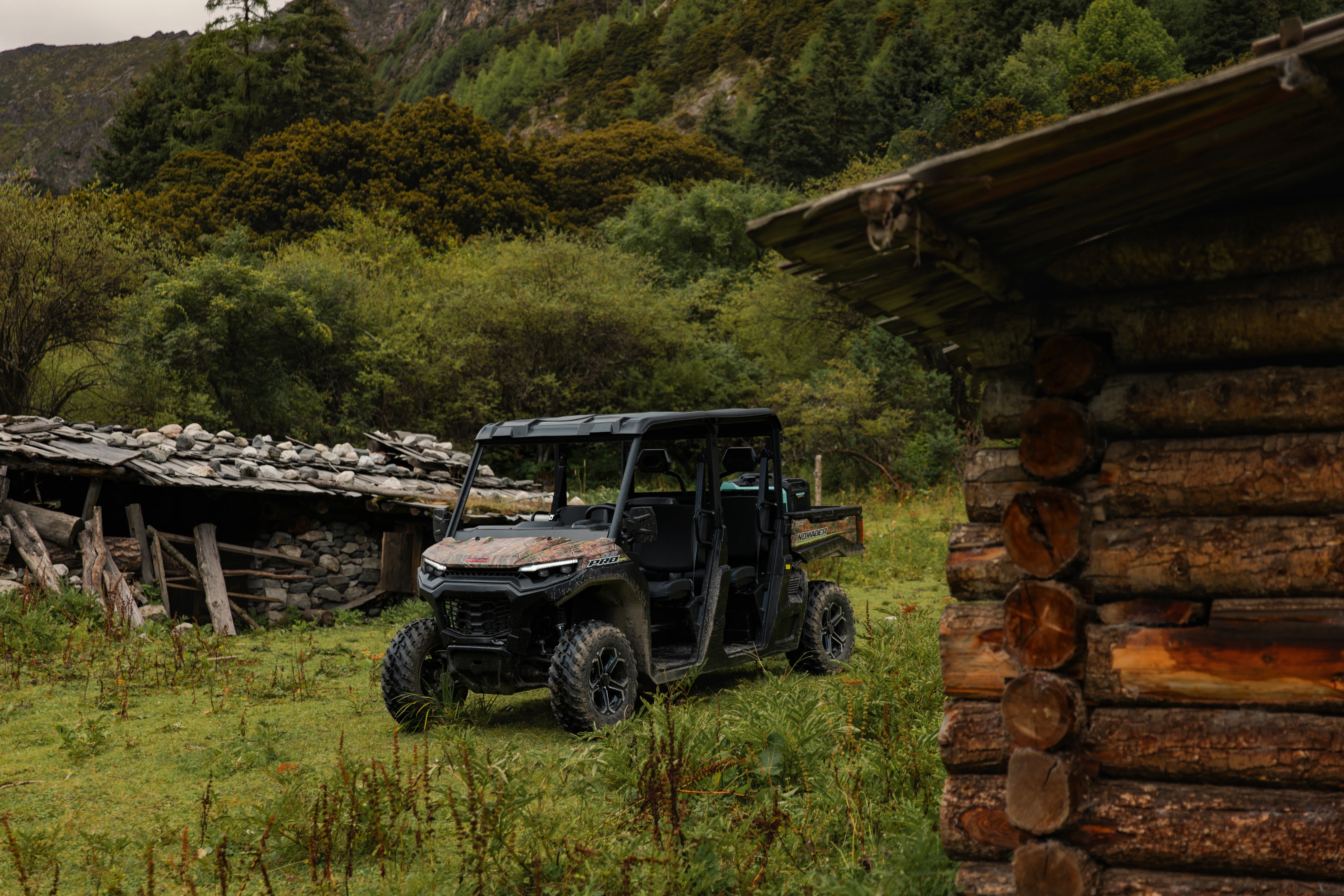

You are halfway up a 35-degree loose shale slope, and your right foot has to leave the throttle to brake for an unexpected obstacle. What happens next — graceful recovery or uncontrolled reversal — depends entirely on whether your vehicle’s hill-hold system was designed by engineers who actually ride. The utility terrain vehicle management team’s IHAC (Intelligent Hill Ascent Control) represents a rethink of how powersports vehicles should handle gradient challenges. Here is how it differs from conventional systems and why the distinction matters in real terrain.
Traditional hill-hold systems operate on a simple principle: when the brake is applied on an incline, a valve locks hydraulic pressure in the brake circuit, holding the vehicle stationary for two to three seconds after the driver releases the pedal. This approach works adequately on paved surfaces but introduces dangerous hesitation on loose terrain, where immediate throttle response is critical for maintaining forward momentum. The IHAC system replaces this passive holding strategy with active intervention that anticipates the driver’s intentions rather than simply reacting to pedal inputs.
The Sensor Suite That Makes IHAC Possible
The heart of the IHAC system is a six-axis inertial measurement unit mounted at the vehicle’s center of gravity. This IMU — the same class of sensor used in aerospace guidance systems — measures pitch angle, roll angle, and angular velocity at 200 samples per second. Combined with individual wheel speed sensors and the 1000cc side by side control unit’s throttle position data, the system builds a real-time model of the vehicle’s dynamic state that traditional hill-hold systems cannot approach.
When the IMU detects a gradient exceeding 12 degrees, IHAC enters a pre-armed state that primes the brake accumulator to 80% of maximum pressure — ready for instant application but not yet engaged. This pre-charging eliminates the 0.3-0.5 second delay that conventional systems require to build brake pressure from rest, a delay that on steep terrain can translate to half a meter of unintended rollback.
| System Component | Function | Specification |
|---|---|---|
| 6-Axis IMU | Pitch/roll/angular velocity sensing | 200 Hz sample rate, ±0.05° accuracy |
| Brake Accumulator | Pre-charged pressure reserve | 80% pre-charge on >12° gradient |
| ECU Integration | Throttle-by-wire coordination | 8ms response from sensor to actuator |
| Wheel Speed Sensors | Individual wheel slip detection | Hall-effect, sealed to IP68 |
The system’s most sophisticated behavior emerges during the transition from holding to moving. Rather than simply releasing brake pressure when throttle is applied — which would create a momentary free-roll period on steep gradients — IHAC modulates brake release in proportion to driveline torque buildup. As the driver applies throttle, the system measures the torque being transmitted through the CVT and releases brake pressure at exactly the rate required to transfer load from the brakes to the driveline without any interruption in forward force. The result feels seamless — the vehicle simply transitions from stationary to climbing as if gravity had temporarily been suspended.
- IHAC activates automatically on gradients above 12 degrees, no driver intervention required
- System maintains hold indefinitely — no time limit unlike conventional 2-3 second systems
- Brake pressure release is torque-proportional, eliminating the “lurch” of binary hold/release systems
- System disengages above 8 km/h or when gradient drops below 8 degrees
- Manual override available via brake pedal for drivers who prefer traditional control
The engineering philosophy behind IHAC reflects a broader trend in powersports vehicle design: the transition from reactive safety systems to proactive assist systems. 1000cc side by side control architecture was designed from the outset to support this evolution, with a CAN bus topology that allows sensor fusion between previously isolated subsystems. IHAC is not an add-on feature bolted to an existing platform — it is a capability that the platform was designed to enable. For riders who regularly tackle terrain where a failed climb means more than bruised pride, that distinction is worth understanding before signing the purchase order.
What sets IHAC apart in practice is how unobtrusively it operates. During a full day of technical riding through the Cascade foothills, the system engaged 47 times — and the driver was consciously aware of perhaps five of those interventions. The remaining 42 activations happened so seamlessly that they registered only in retrospect, when reviewing the telemetry log and realizing how many hill starts would have required two-foot coordination without assistance. This invisibility is the highest compliment an assist system can receive — it doesn’t announce itself, it simply removes a problem the driver never has to solve. The 1000cc side by side team’s calibration philosophy clearly prioritized transparency over theatrical intervention, and the result is a system that makes technical climbing accessible without making it feel artificial.
The IHAC system’s development history reveals an interesting engineering decision that explains its unusual effectiveness. Most hill-hold and hill-descent systems in the powersports industry are brake-based: they modulate hydraulic pressure at each caliper to control vehicle speed on slopes. IHAC takes a fundamentally different approach by integrating with the CVT’s engine-braking characteristics. When IHAC detects a descent, it electronically commands the CVT to maintain a lower ratio than the throttle position would normally dictate, using engine compression braking as the primary speed control mechanism and engaging the brakes only as a secondary supplement. This strategy provides two significant advantages: first, it eliminates the brake-fade risk that pure brake-based systems experience on long descents where continuous friction generates pad temperatures that degrade stopping performance; second, it delivers smoother speed control because engine braking is inherently more progressive than hydraulic braking, without the grab-release-grab cycling that brake-based systems exhibit as individual wheels encounter variations in traction. The system’s grade detection algorithm uses a six-axis inertial measurement unit — the same sensor technology used in drone flight controllers — sampling at 200 Hz, which allows IHAC to detect grade changes within 0.3 seconds of the vehicle’s attitude change. The system has now been deployed across 4,000 production Nomaders, and the warranty data shows zero IHAC-related failures and a 17% reduction in brake pad replacement frequency compared to non-IHAC Nomader models — a secondary benefit that the engineering team anticipated but did not emphasize in the initial product launch.