

Every few years, a new well intervention technique arrives that changes how operators think about their wells, and snubbing is one of them. By keeping the well alive while pipe is moved in and out, snubbing cuts downtime and protects reservoirs that cannot tolerate being killed, but it also demands a level of crew skill that traditional training simply cannot produce. That is why the snubbing drilling simulator has moved from a curiosity to a core tool for operators adopting snubbing as a standard practice.
Adopting a new process safely requires a deliberate training path. Operators who simply buy a simulator and let crews play with it see disappointing results, while operators who build a staged curriculum see measurable improvements in safety and efficiency within a single year. This guide lays out a route that has worked across multiple regions, from the trainee who has never seen a snubbing unit to the veteran who needs to master the newest procedures.
Why New Process Training Demands Simulation
Snubbing is a process where the cost of a mistake is measured in lives and wells, and where the old apprenticeship model no longer works. The experienced hands who once taught snubbing by example are retiring, and the industry has not produced enough replacements. At the same time, operators are pushing snubbing into new applications, from underbalanced workovers to deepwater interventions, which means even experienced crews face procedures they have never performed. Simulation is the only scalable way to build competence in a process that cannot be practiced on a live well.
A snubbing drilling simulator solves the training problem in three ways at once. It lets trainees repeat high-risk procedures as many times as needed, it injects failures and emergencies that no operator would allow on a real job, and it records everything for objective assessment. For a company rolling out snubbing across multiple rigs, those three capabilities are exactly what make consistent, certifiable training possible.
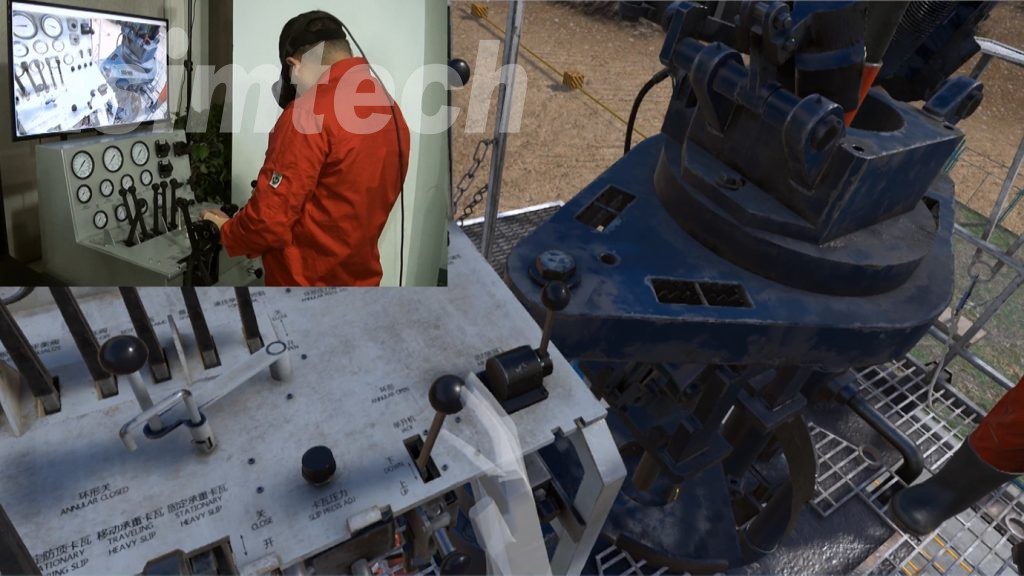
Stage one of the path is foundation building. Trainees learn the physics of snubbing: how string weight, wellbore pressure, and snub force interact, and why the crossover point is the critical moment of every operation. They study the hardware, from the travelling head to the slips and the BOP stack, and they practice rig-up procedures on the simulator until the sequence is automatic, a milestone the snubbing simulation training system tracks from the first session. The visual system plays a central role here, because trainees must learn to read the wellsite environment, the choke manifold, and the crew positions the same way they will on location.
Stage Two: Building Procedural Fluency
Once the foundation is in place, trainees move to procedural fluency: executing complete snub-in and snub-out operations from start to finish. Instructors start with simple, single-string exercises and progressively add complexity, changing wellhead pressures, introducing heavier strings, and varying the equipment configuration. At this stage the snubbing simulator’s real-time force model becomes the primary teacher, because every control movement produces an immediate, physical response that the trainee can feel and correct.
Team coordination enters the picture at this stage as well. Trainees rotate through the roles of snubbing operator, BOP handler, and floor supervisor, learning how the crew communicates during a job. Operators consistently report that graduates of team-based simulator training communicate more clearly and make fewer coordination errors on their first real jobs. The recorded playback of each session gives the instructor a precise tool for showing a crew exactly where their coordination broke down.
Stage Three: Advanced Scenarios and New Processes
The third stage is where snubbing training connects to the broader adoption of new processes. Trainees practice snubbing in underbalanced conditions, work with pipe light and heavy strings, and rehearse the procedures specific to new applications such as snubbing with coiled tubing or during well kill operations. The simulator’s scenario library is expanded with the company’s own procedures, so the training reflects exactly how the operator wants the job done, not a generic textbook version. A snubbing simulation training system that is configured around a company’s own procedures becomes a powerful tool for standardizing how that company works.

Emergency response is threaded through this stage. Instructors inject seal failures, stuck strings, and sudden pressure surges into otherwise routine exercises, forcing crews to practice the responses they will need if something goes wrong on location. Because every emergency drill is recorded, instructors can track response times and error rates over multiple sessions, showing crews concrete evidence of their improvement. This data-driven approach turns a vague goal like “be ready” into a measurable standard.
Stage Four: Assessment and Continuous Development
The path ends, and never ends, with assessment. Trainees complete graded exercises that cover routine operations, emergency response, and team coordination, with scores generated from recorded data. A snubbing simulator assessment gives operators a verifiable record of what each crew member can do, which supports certification decisions and satisfies the documentation requirements of modern safety management systems.
For the operator rolling out a new process, the assessment stage doubles as a quality control loop. Data from simulator sessions feeds back into the procedure library, identifying the steps where crews struggle and the scenarios where errors concentrate. Procedures are then revised, and the improved versions are trained and assessed again. This continuous improvement cycle is the real payoff of adopting snubbing simulation training: the system does not just train people, it also trains the process itself.
From the first day of foundation training to the first certified snubbing job, the full path typically takes ten to fourteen weeks, and the investment returns through safer operations, faster crew readiness, and fewer nonproductive events. The snubbing drilling simulator is not a substitute for experience, but it is the fastest and safest way to build it, and for operators adopting snubbing as a new process, it is the difference between hoping crews are ready and knowing they are. Start with a clear staged plan, configure the system around your own procedures, and let the data drive improvement, and the training path will carry your crews from beginner to expert.